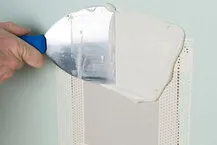
Walls in Pittsburgh are as often plaster as drywall. Plaster cracks along the lath lines and around doors, and ceilings below bathrooms pick up water stains. Newer homes get nail pops, dents and holes. We repair both kinds of wall, feather the patch wide, prime it and repaint the wall so the repair does not show.
In Pittsburgh a wall repair is as likely to be plaster as drywall. Houses built before 1940 have plaster over wood lath, and many have been patched over the years with pieces of drywall, so one room can hold both. Hilly ground and old foundations let houses settle a little, which shows up as cracks running from the corners of doors and windows. Newer homes and finished basements are drywall, with the usual dents, nail pops, torn paper and holes from door handles.
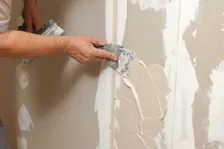
We find out what the wall is made of and why it failed before we fix it. A small hole in drywall gets a backed patch. A larger one is cut square and a new piece is screwed in. Plaster cracks are opened, taped or filled and skimmed. Loose plaster is fastened back or cut out and replaced. Joint compound goes on in several thin coats, each one wider than the last, then it is sanded, primed and painted so the patch blends into the wall.
Water stains need a word of caution. A brown ring on a ceiling under a bathroom or below the roof means a leak, and the leak has to be fixed before the ceiling is. We can tell you what we see, but a plumber or roofer handles the source. Sanding makes dust, so we close off the room and cover the floor. In a house built before 1978, cutting into painted walls is done with lead-safe methods. Estimates are free.
Drywall repair in Pittsburgh: common questions
Can you repair plaster, or only drywall?
Both. Many Pittsburgh homes have plaster, and most cracks and small loose areas can be repaired without tearing the wall out. Where plaster has come away from the lath over a wide area, replacing that section with drywall is sometimes the better fix.
Why does the same crack keep coming back above my door?
Cracks at the corners of doors and windows follow movement in the house. Filler alone will split again. Taping the crack and skimming over it holds far better, though a house that is still moving can open any repair in time.
Will the patch show after it is painted?
A patch done in wide, thin coats and primed should not show. The paint is the harder part. A fresh spot on an old wall can look different, so we usually repaint the whole wall from corner to corner.
How it works
- Free estimate: Call, text or book online. We walk the job and measure.
- Written quote: Prep, paint and price in writing.
- Prep & protect: We cover floors and furniture, repair and prime surfaces.
- Paint & walk-through: Two coats, clean lines, full clean-up and a final walk-through.